

i46 s.r.o. and Rinicom Ltd (Czech Republic and United Kingdom) is one of the 8 winners of the COP-PILOT 1st Open Call. Their project, QUANTUM-RESILIENT 5G (Quantum-Resilient Private 5G for Business Integration in Underground Mining), is part of Cluster 1 (Mining). We asked the team about their company, the challenge they address and the impact they expect.
Could you briefly introduce your company and describe its main activities?
QUANTUM-RESILIENT 5G is delivered by a two-partner SME consortium. i46 s.r.o. (Prague, Czech Republic, and coordinator) is a cybersecurity SME focused on quantum-secure communications and Cyber Resilience Act compliance for industrial and critical-infrastructure operators. Its product portfolio spans quantum-enabled data storage and sharing, a private 5G Standalone core, and compliance tooling that today monitors approximately 1,000 connected IoT devices. Rinicom Ltd (Lancaster, United Kingdom) is a secure-communications SME with 30+ years of secure-RF experience, including the Piccadilly-Line train-to-platform infrastructure for London Underground; its leaky-cable product is deployed in critical transportation and now mining. The two partners previously delivered the DARK-5G project under the FIDAL Open Call, reaching TRL 7 in underground conditions. QUANTUM-RESILIENT 5G is the direct successor, taking that TRL-7 subsystem into COP-PILOT and operational mining.
What challenge are you addressing under the COP-PILOT Horizon’s first Open Call, and how is your proposal relevant to the challenge?
Underground mines are connectivity dead-zones: public networks don’t reach below ground, and fibre backbones typically terminate at fixed installations along main haulageways rather than in active working zones. Mining operators consequently run digital systems on legacy radio or bespoke on-site installations that demand specialist visits for installation, configuration and ongoing maintenance. Both options foreclose the workflows that today most need continuous data: predictive-maintenance dispatch, real-time control of autonomous and remotely-operated underground equipment, real-time seismic safety response, ore-flow analytics, and regulatory reporting. Where teleoperation is deployed, operators are forced into a poor trade-off: station crews underground (defeating the safety motivation) or accept unauthenticated control channels (a Cyber Resilience Act compliance risk).
QUANTUM-RESILIENT 5G addresses this with a turnkey, secure connectivity stack purpose-built for underground operations and natively integrated with the COP-PILOT platform. A surface Ground Station will host a private 5G Standalone core, a quantum-secured authentication engine, AI-driven network monitoring and edge compute; the 5G signal will reach underground through Rinicom’s leaky cable.
The project supports all four Cluster 1 use cases (UC 1.1 RockSigma seismic monitoring, UC 1.2 ThingWave smart rock-bolts, UC 1.3 Hosch+Predge conveyor predictive maintenance, UC 1.4 IoT-Edge-Cloud Continuum testbed at RISE ICE) and advances all three COP-PILOT platform objectives: open multi-layer orchestration, AI-based service onboarding via LLM-UI, and secure declarative-policy management via GitOps.
The relevance to the Open Call is clear: the project extends the COP-PILOT Domain model into a new class of environment (security-restricted, intermittently-connected, underground) without architectural change to the platform.
What is the expected impact of your proposal?
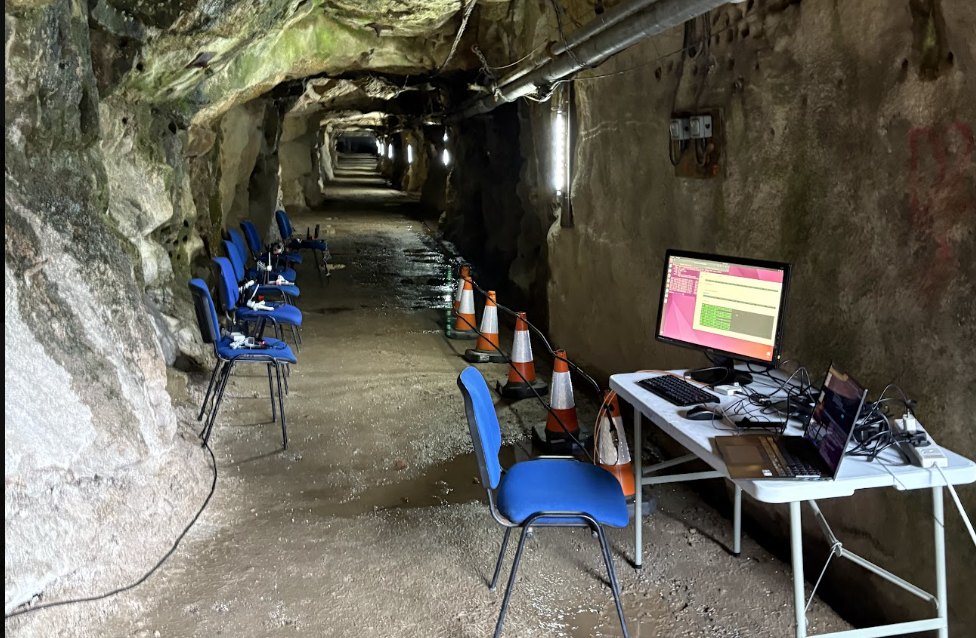
Over 8 months, QUANTUM-RESILIENT 5G will advance from TRL 5 to TRL 7 through validation at the RISE ICE Datacenter (Luleå) and field demonstration at Holman Test Mine (Cornwall, UK), where 200 m of leaky cable, a VisualFusion+ control-room system and a tunnel-mounted robotic arm are already installed by Rinicom.
Technical impact. Two reusable extensions will be contributed to COP-PILOT:
- a ColonyOS-coupled 5G-domain telemetry pattern that feeds live radio-network conditions back into the platform’s decision on where to run each compute job: a feedback loop classical telco automation frameworks do not provide;
- an extreme-edge connectivity-domain blueprint that extends the Domain model into security-restricted, intermittently-connected mining environments.
Both are domain-agnostic and reusable across CL2, CL3e and CL3a. The project also produces a new demonstration of LLM-UI against industrial OT workloads.
Economic impact. The integrated stack will be commercialised by i46 and Rinicom as a Mining Connectivity Pack, addressing a European mining and quarrying sector that employs 371,000 people and generates €64.1 billion of annual value added. This sector is under growing digitalisation pressure from the Critical Raw Materials Act and the Cyber Resilience Act. The Holman installation will remain in place beyond M9 as a live commercial reference deployment.
Social and environmental impact. Authenticated teleoperation enables removal of personnel from hazardous tunnel zones (drilling, scaling, post-blast inspection); predictive maintenance reduces unplanned downtime by 20-30% per industry benchmarks; the remote-management plane reduces operator-transit carbon footprint between sites.
Open outputs. All integration source code will be released on GitHub under Apache 2.0; validation datasets on Zenodo under CC-BY 4.0; a cross-cluster transfer study will be published open-access. Dissemination includes a COP-PILOT community workshop and a presentation at a relevant Forum.