


Random Red (Croatia) is one of the 8 winners of the COP-PILOT 1st Open Call. Their project, ISOBUS-TRACE (Edge-AI Activity Recognition and EBSI-Compatible Blockchain Traceability for Onboard Tractor ISOBUS Logging), is part of Cluster 3A (Agriculture). We asked the team about their company, the challenge they address and the impact they expect.
Could you briefly introduce your company and describe its main activities?
Random Red d.o.o. is an R&D-focused technology SME based in Croatia, specialising in edge computing, blockchain, and machine learning. The company works at the intersection of privacy-preserving computation and trusted data infrastructure, with a particular focus on digital metrology and AI deployed under real-world resource constraints. Random Red has delivered several projects, including work on fully homomorphic encryption, data spaces for distributed data processing and privacy-preserving edge-cloud architectures. The company is a participant in the EBSI Early Adopter Programme and contributes to European standardisation through various metrology and digitalization working groups.
What challenge are you addressing under the COP-PILOT Horizon’s first Open Call, and how is your proposal relevant to the challenge?
ISOBUS-TRACE addresses Challenge 4 of Cluster 3A: Onboard Tractor and Machinery Activity Logging for FMIS & ISOBUS Integration.
Agricultural traceability today has a structural gap. Farm management systems know what is growing on each parcel; logistics ledgers know what happens after harvest. But what occurs in between – which operations a tractor actually performed, when, where, and at what cost in fuel and emissions – is largely undocumented or manually recorded. Machinery data exists on the ISOBUS CAN bus, yet it remains locked inside proprietary vendor ecosystems, is not interoperable across brands, and is not connected to any verifiable provenance chain.
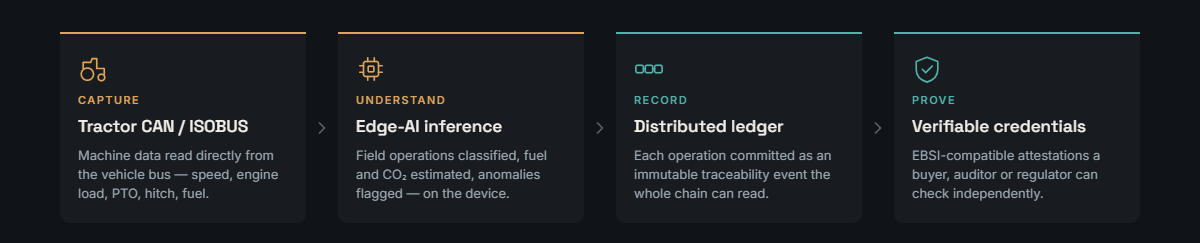
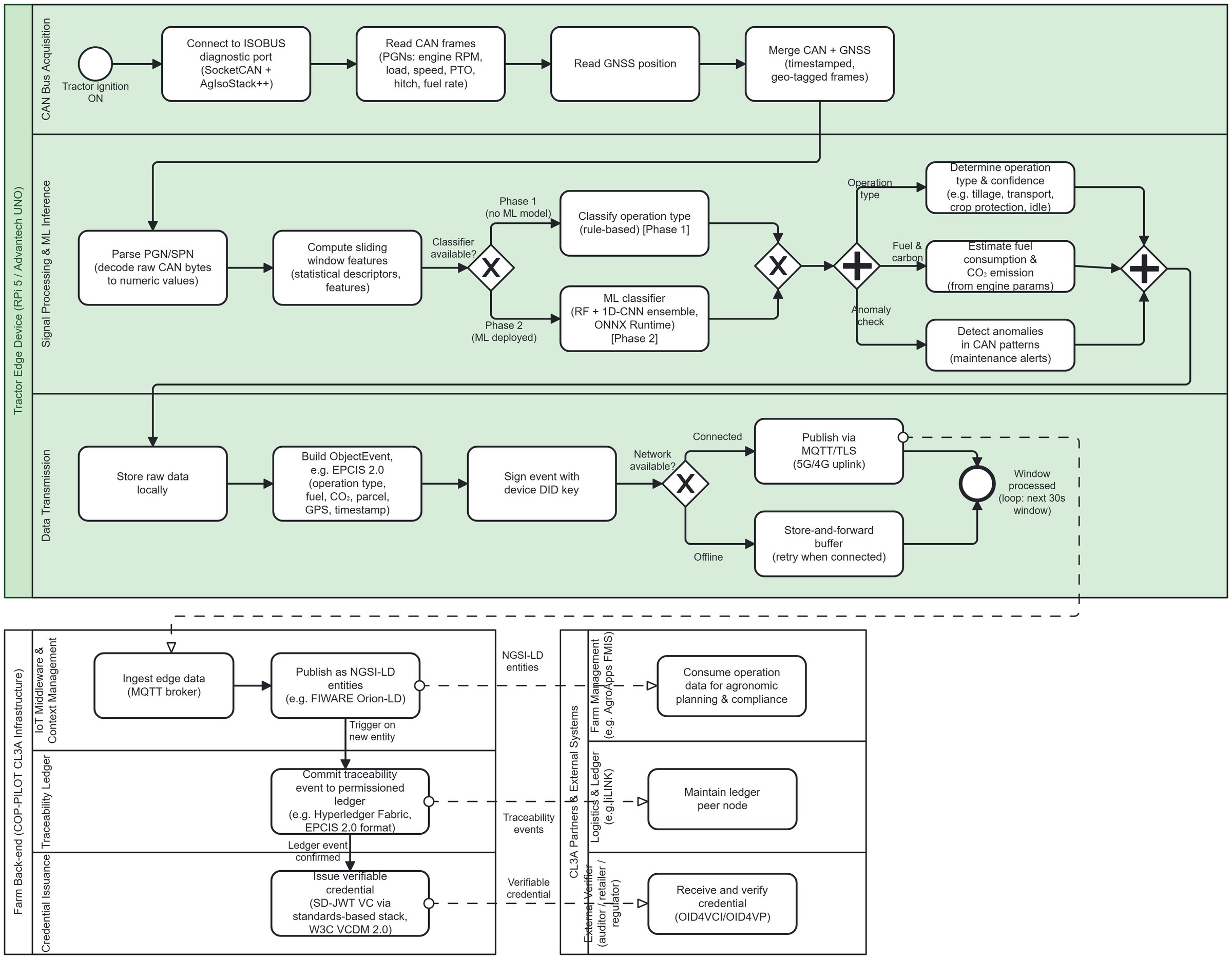
ISOBUS-TRACE deploys a dedicated edge device on ISOBUS-equipped tractors at the ATSI testbed in Kilkis. The device reads CAN bus data directly, classifies agricultural operations using on-device machine learning, estimates fuel consumption and CO₂ emissions from engine parameters, and detects anomalies indicating maintenance needs. Results are published as NGSI-LD entities into the COP-PILOT FIWARE layer, committed to Hyperledger Fabric as GS1 EPCIS 2.0 traceability events, and attested as EBSI-compatible verifiable credentials.
The proposal is also relevant to COP-PILOT more broadly: the architecture exercises the full platform stack – edge, secure cross-domain connectivity, orchestration, context brokering, and distributed ledger – in a single end-to-end scenario. The edge device and all software are transferred to Cluster 3A at project end, providing the cluster with a permanent machinery-level edge-AI capability it does not currently have.
What is the expected impact of your proposal?
Technical and scientific. ISOBUS-TRACE extends COP-PILOT with a composite service combining edge intelligence, permissioned blockchain, and verifiable credentials across tractor, farm, and logistics domains. Thereby, the project addresses three research gaps: whether machine learning outperforms rule-based classification for tractor operation recognition from CAN bus signals; whether edge-deployed fuel estimation is sufficiently accurate for credible carbon attestation; and whether EBSI-compatible credentials are practical for agricultural attestations.
Environmental and social. Per-operation carbon footprinting enables data-driven emission reduction in a sector where current accounting relies on generic assumptions. Verified farm-to-fork provenance supports consumer trust and reduces the trust asymmetry between small producers and large retailers.
Economic. Cross-brand ISOBUS interoperability reduces farmer vendor lock-in. Automated operation logs replace manual record-keeping. The hardware is affordable, making adoption viable for small and medium farms rather than only large operations.
Replicability. The architecture transfers directly to other COP-PILOT clusters: mining equipment shares the same J1939 communication protocol, vineyard machinery uses identical ISOBUS interfaces, and the credential pattern is domain-agnostic. All models and data models are released under open licences with cross-domain adaptation documentation.