




As cloud-native applications move across cloud and edge environments, resource scheduling becomes much more than deciding where a workload fits. Modern applications are built from many microservices that depend on one another, exchange data continuously, and often run across different clusters. Where each service is placed can directly impact performance, latency, and infrastructure costs.
This is the challenge addressed by recent OneSource research on AI-driven resource scheduling. The work examines how scheduling decisions can become more intelligent by taking into account not only available resources but also workload behaviour and communication patterns between services.
AI-Driven Scheduling and Orchestration
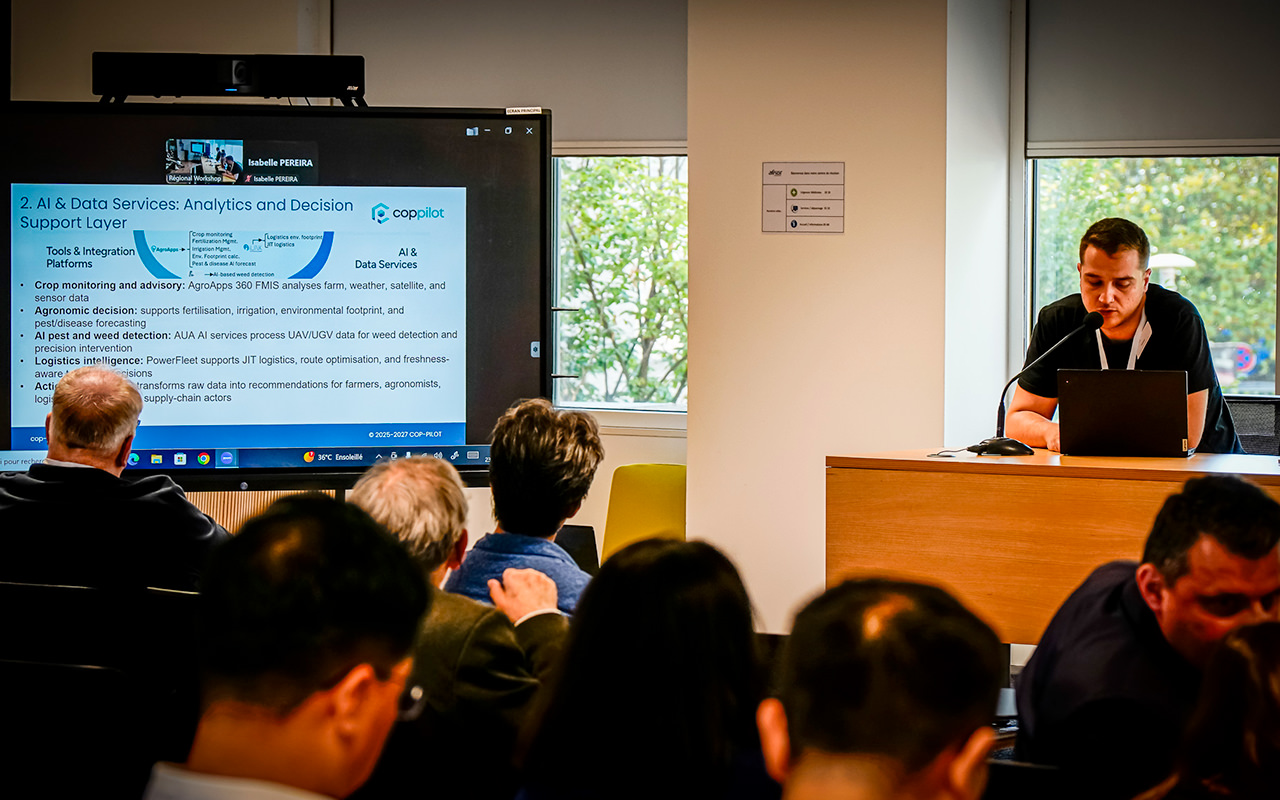
At AIAI 2025 in Limassol, João Fernandes from OneSource presented “Cloud-Native Scheduling and Resource Orchestration: A Deep Dive into AI-Driven Approaches.” The presentation focused on how Artificial Intelligence can support scheduling and orchestration in cloud-native environments.
Traditional scheduling approaches often rely on predefined rules or fixed policies. While useful, these mechanisms can be difficult to adapt when workloads change quickly or when applications are deployed across distributed infrastructures. AI-driven approaches offer another path: using operational data to support more informed and adaptive scheduling decisions.
By applying techniques such as machine learning and deep reinforcement learning, schedulers can learn from resource usage patterns, anticipate demand and improve workload placement over time. This can help cloud-native platforms make better use of available infrastructure while reducing the need for manual tuning.
Resource- and Latency-Aware Scheduling
A complementary contribution was presented at IEEE CCNC 2026 in Las Vegas by Luís Cordeiro and Luís Ferreira from OneSource. Their work, “Resource-and-Latency-Aware PSO for Cloud-Native Scheduling,” introduced RALA-PSO, an extension of Particle Swarm Optimization for microservice placement.
RALA-PSO was designed with a specific problem in mind: in cloud–edge environments, the best placement is not always the one that simply balances resources. Microservices often communicate intensively with one another. If closely connected services are placed far apart, the application may suffer from higher latency and increased network overhead.
To address this, RALA-PSO considers both resource availability and service communication patterns. It evaluates CPU and RAM usage while also accounting for dependencies between microservices, allowing placement decisions to better reflect how the application actually behaves.
The work was complemented by a live demonstration of the scheduling algorithms, showing how different placement strategies behave under changing workload conditions and how resource- and latency-aware scheduling can support more efficient cloud–edge deployments.
Why This Work Matters
Efficient resource scheduling is becoming a key requirement for cloud–edge infrastructures. Applications need to run close enough to users and data sources to reduce latency, while still making efficient use of available cloud and edge resources.
This creates a complex scheduling problem, especially in multi-cluster environments. Schedulers must balance performance, resource usage, and communication costs simultaneously.
RALA-PSO introduces several enhancements to make Particle Swarm Optimization suitable for this context. Evaluations using the Alibaba Cluster Trace V2018 dataset showed promising results, including reduced communication costs and faster placement decisions compared with other scheduling approaches.
Relevance to COP-PILOT
This research is closely aligned with the objectives of COP-PILOT, which focuses on intelligent service management and automation across multi-domain infrastructures.
AI-driven resource scheduling is an important part of that vision. As services are deployed across cloud, edge, and multi-domain environments, scheduling decisions need to be more aware of infrastructure conditions, service dependencies, and performance requirements.
Through its work on AI-driven orchestration and Swarm Intelligence, OneSource contributes to smarter workload placement and more efficient cloud–edge resource management.