




- This event has passed.
February 3, 2025 @ 1:00 pm - 2:30 pm
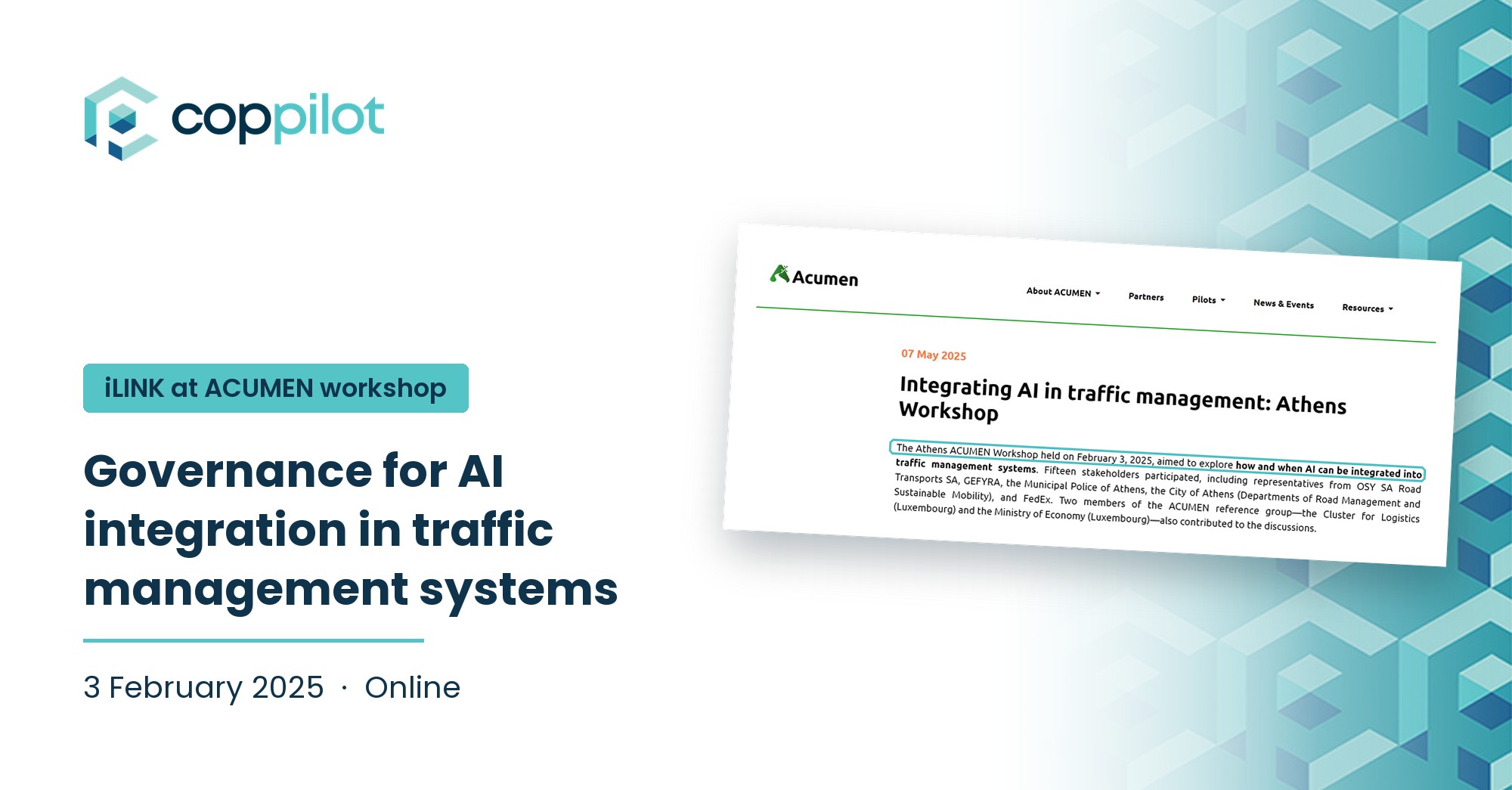
iLINK Contributed to the Stakeholder Dialogue on Governance for AI Integration in Traffic Management Systems
iLINK took part in the stakeholder workshop “Governance for AI integration in traffic management systems”, organised for the Athens pilot of the ACUMEN project, which is developing a governance and regulatory framework and a decision-support tool for the introduction of artificial intelligence and machine learning into transport management systems. The session was run as a closed roundtable with a small group of stakeholders from public transport operators, infrastructure concessionaires, municipal authorities and logistics operators, so iLINK contributed through the discussion rather than through a formal presentation.
The conversation turned on two questions that COP-PILOT is addressing directly. The first was where the data needed to run AI in transport actually comes from, and who is accountable for it: participants described fragmented systems, the absence of a common data-sharing model and monitoring tools with no predictive capability. iLINK contributed the perspective it is building in COP-PILOT, where operational data from vehicles, edge devices and business systems is exchanged through standardised, interoperable interfaces rather than point-to-point integrations, so that data can be shared between organisations without either side surrendering control of its own systems.
The second was trust. Much of the discussion concerned transparency, auditability and human oversight of algorithmic decisions, and the recommendation that emerged was collaborative governance between public authorities, private companies, academia and civil society. iLINK contributed the view that trust in AI-supported transport decisions depends on the provenance of the data behind them being verifiable — the problem COP-PILOT addresses through permissioned distributed-ledger traceability, where the record of what happened, when and by whose authority cannot be altered after the fact. The same mechanism that lets a food batch be traced from field to shelf can make an AI-supported operational decision auditable.
iLINK also noted the relevance of COP-PILOT’s just-in-time logistics work to the inefficiencies in freight and last-mile delivery that participants identified as a contributor to congestion in the Athens metropolitan area: routing that responds to real conditions rather than to a fixed plan reduces empty running and unnecessary vehicle-kilometres, which is a traffic management outcome as much as a logistics one.
For COP-PILOT, this was an Industry & Use-case activity addressing an industry and public-authority audience. It supported the project’s dissemination and policy-engagement objectives by bringing COP-PILOT’s approach to interoperable data exchange, verifiable provenance, and smart logistics into a governance-focused discussion on the deployment of AI in European transport systems.