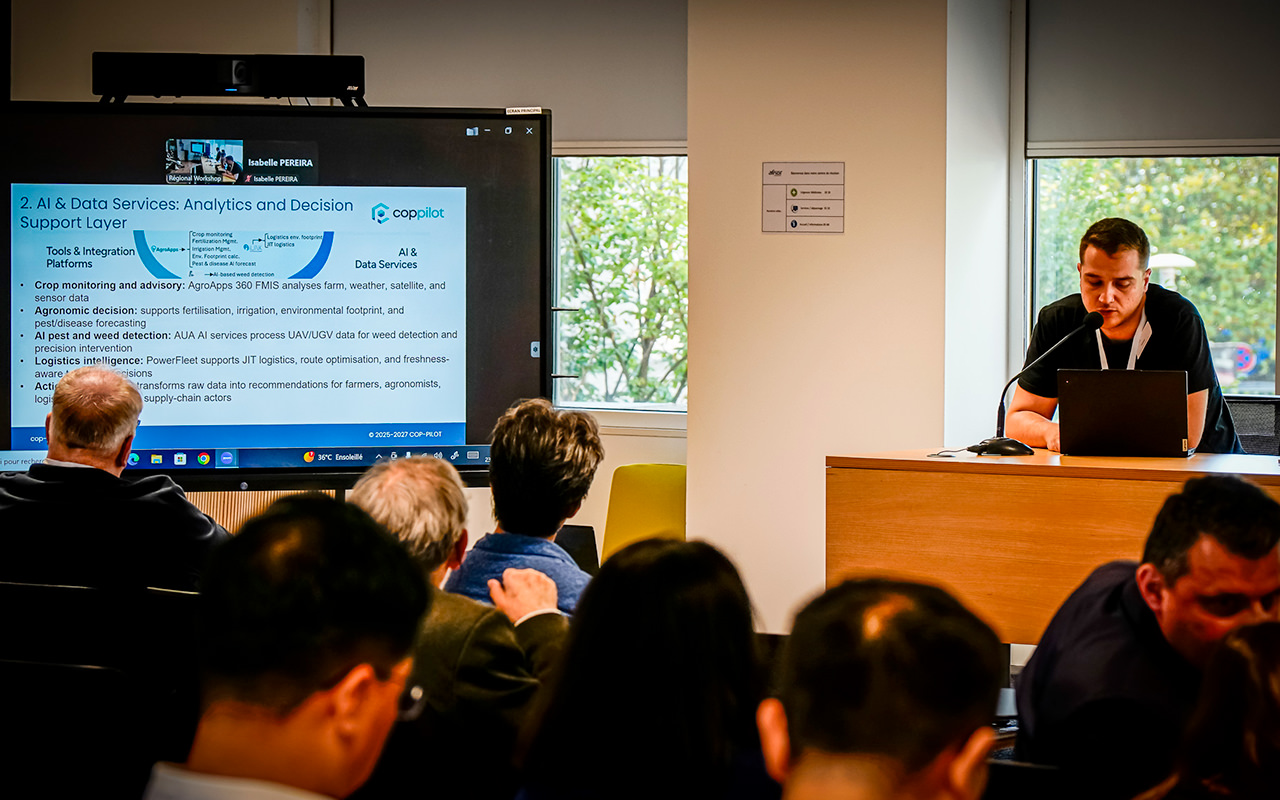



In November 2025, a consortium of partners from COP-PILOT and ACROSS projects joined forces in an ETSI-organized webinar to present ETSI ZSM Proof-of-Concept #16, a compelling demonstration of what the future of automated, secure, multi-domain orchestration can look like. Led by experts from several academic and industrial partners*, the session showcased how modern orchestration platforms can seamlessly manage services across private infrastructures distributed across Europe.
A Turning Point for Multi-Domain Orchestration
As digital services evolve, they increasingly span multiple administrative domains (different infrastructures, operators, security policies, and resource types). Managing such environments is highly complex. The webinar opened by framing this challenge: joint service and network orchestration is no longer optional. It is essential for meeting stringent requirements around security, trust, privacy, and the coordination of heterogeneous compute, network, and service resources.
This is the context in which ACROSS and COP-PILOT placed their demonstration: proving that a multi-domain orchestration platform can operate securely and automatically across edge, cloud, and 5G networks, while maintaining service levels and adhering to open standards.
A real-world, cross-border setup
The PoC connected three real testbeds located in Athens, Patra, and Madrid, owned by UBITECH, UoP/P-NET, and Telefonica (TID), respectively. The presenters guided the audience through the distributed architecture, explaining the roles of each testbed and detailing the hardware, orchestration components, and services deployed across them.
Four scenarios that bring multi-domain orchestration to life
Scenario 1 – Onboarding a new private domain: The owner of a new private domain in Patra (Greece) becomes a new customer of the orchestration platform and wishes to add this domain under the platform’s realm for enabling business to local stakeholders in the city of Patra. This scenario shows how a set of simple steps guided by a user portal allows this private domain to become part of a large platform, thus offering IT (edge cloud and 5G) services to local customers in the city of Patra.
The business value of this scenario is the ability to onboard new stakeholders effortlessly, eliminating VPNs and complex infrastructure setup. It securely registers private resources through full encryption and zero-trust principles, enabling fast, trusted integration into the orchestration platform.
Watch the video presentation here
Scenario 2 – Deploying a complex service with a click: A new customer in the newly onboarded domain wants to deploy a 5G video streaming service across different sub-domains. The platform offers nice service bundles that allow this service to be deployed almost in a fully automated manner, despite the complexity of the underlying setup. This scenario shows can such a complex service can be materialized in a few minutes, with no VPNs or complex setup. It enables rapid integration of private resources into the orchestration platform while ensuring full encryption, zero-trust security, and a fast, trusted path to service deployment.
Watch the video presentation here
Scenario 3A – Strengthening security on demand: After the service gets deployed, the service owner desires to increase the runtime security of certain service components, to fortify the service and its users from potentially malicious attacks. The platform offers a service tailored to the needs of the customer, which gets deployed in the blink of an eye. The business value of this scenario is the ability to add security enhancements to running services instantly and without disruption. By offering security-as-a-service through automated orchestration, it provides rapid, zero-configuration protection—crucial for defending against modern cyber threats.
Watch the video presentation here
Scenario 3B – Predicting and preventing SLA violations: The service owner now appears with a performance requirement for the 5G video streaming service. The platform allows the service owner to express this requirement as a formal Service Level Agreement (SLA), offering a predictive approach to meet this SLA. A closed loop is demonstrated between the central domain in Athens and the edge domain in Patra, where a smart Analytics model exploits service telemetry to forecast potential SLA violations, thus proactively notifying the orchestrators to adapt the service in time, before the SLA gets violated. For businesses, this ensures uninterrupted service, protects revenue by avoiding SLA penalties, and enhances customer satisfaction, supporting future business growth.
Watch the video presentation here
Across all four scenarios, the PoC achieved 64–86% automation, demonstrating a practical pathway to near-zero-touch operations even in highly complex environments.
Turning the Concept into a Working Multi-Domain System
During the webinar, a multi-domain system was introduced. It is based on open-source components and it allows telco operators, (edge) cloud providers, large industries, and stakeholders across different business sectors to collaboratively offer modern types of services, using: (i) standardized TMForum APIs (adopted by the industry today) and (ii) a user-friendly portal that realizes critical user operations with a high degree of automation, increased security, and zero-trust among the participating parties.
The operations demonstrated in this PoC cover:
- The registration of a new private domain under the platform, showing how quickly an orchestration platform expands towards private infrastructures and new stakeholder environments in a secure and trusted manner.
- The end-to-end provisioning of compute, network (5G), telemetry, and end-user services in a private edge domain in a fully automated way.
- The runtime protection of a modern service with on-demand security as a service.
- The proactive SLA preservation of a modern service through Analytics training and Inference, and an automation service that closed the loop via standardized service update APIs.
What was adopted/what will be considered by ETSI?
Three ETSI open-source platforms [ETSI OpenSlice (acting as a domain orchestrator), ETSI OSM (acting as an NFV Orchestrator), and ETSI TeraFlowSDN (acting as a transport network SDN controller)], as well as a new ETSI OpenSlice MDG based on Maestro were employed to orchestrate the entire PoC. These platforms demonstrated strict conformance to:
- TMForum APIs at the resource (TMF 634, 652, and 639 APIs), service (TMF 633, 641, and 638 APIs), performance (TMF 628), and SLA (TMF 623 API) management levels,
- adoption of ETSI NFV SOL005 API for NFV management,
- ETSI ZSM architecture as per ETSI ZSM 002,
- end-to-end management of network slicing as per ETSI ZSM 003,
- cross-domain end-to-end service lifecycle management as per ETSI ZSM 008,
- network digital twins for network management as per ETSI ZSM 018 specifications, and
- 3GPP rel. 17 specifications for the demonstrated end-to-end 5G deployment.
This PoC proves the dedication of ETSI Software Development Groups to developing open standards across multiple SDOs for delivering a holistic platform for 6G in the near future.
Looking forward

The ETSI ZSM PoC 16 webinar offered more than a technical demonstration; it presented a vision of how telco operators, cloud providers, industrial stakeholders, and research communities can collaborate through open, secure, automated orchestration frameworks. The PoC materials, including presentations, videos, and the final report, now feed directly into ETSI’s ongoing standardization work.
For COP-PILOT and ACROSS, this marks another step toward building real-world platforms capable of managing distributed, intelligent, and SLA-aware services across domains and sectors.
As digital infrastructures continue to expand and interconnect, demonstrations like this help shape the foundations of a future where orchestration is not a bottleneck, but a catalyst for innovation.
Want to understand more? Read the attached documentation and watch the videos:
- ZSM PoC proposal document
- ZSM PoC proposal presentation (Sept. 9, 2025 at ETSI ZSM #32 plenary meeting)
- ZSM PoC demo presentation (Nov. 14, 2025 at ETSI ZSM Webinar)
- ZSM PoC dissemination material (videos)
- ZSM PoC report (delivered to ETSI ZSM to close the PoC)
Participant organizations to the ETSI ZSM PoC 16 webinar: UBITECH (UBI), University of Patras (UoP), p-NET, NOVA, K3Y, Centre Tecnològic de Telecomunicacions de Catalunya (CTTC), WINGS ICT Solutions (WINGS), Ericsson Ireland (ERI-LMI), Telefonica (TID), Universidad Politecnica de Madrid (UPM)